
Samos History, Greece: Polycrates, Pythagoras and the Sanctuary of Hera
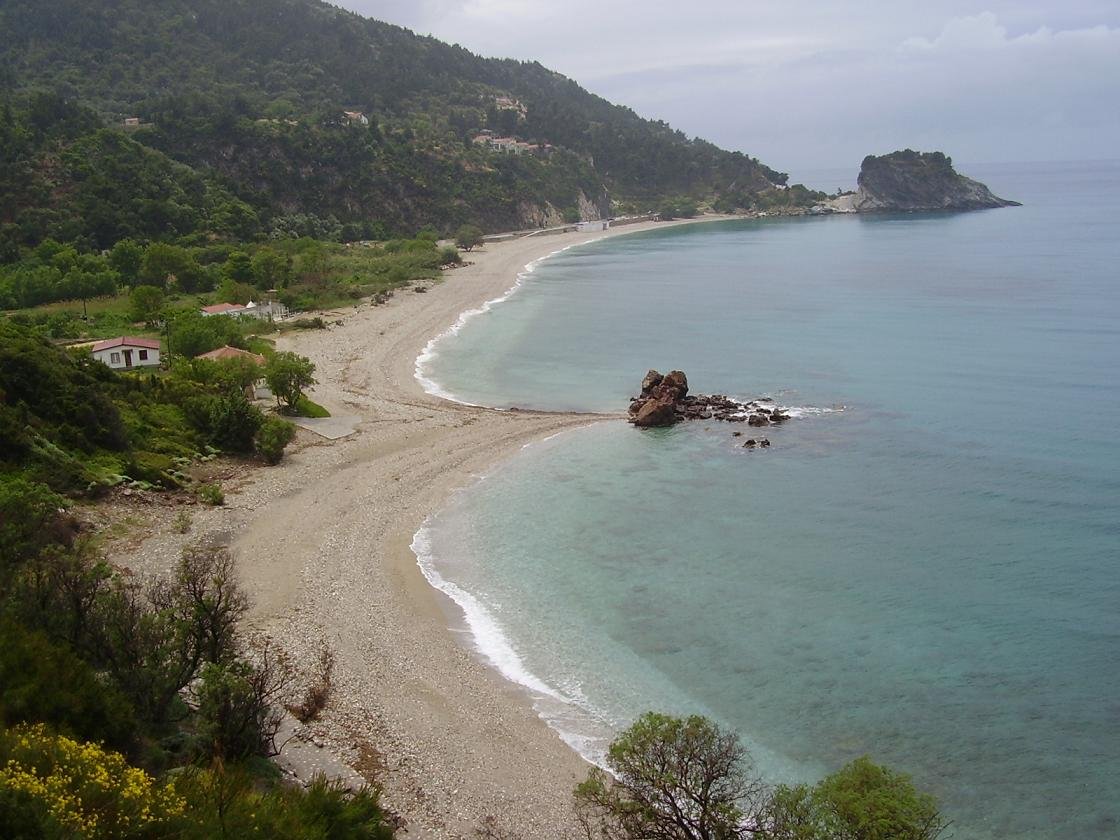
The Ionians settled Samos around 1000 BC, and under the tyrant Polycrates (about 540-521 BC) the island reached its peak as an economic and cultural centre. Samos became Roman in 132 BC and part of Greece again in 1912. It is the birthplace of the mathematician Pythagoras and the site of a great sanctuary of the goddess Hera - both of which you can visit today, as shown on the Samos sights page.
- Ionians arrive
- ~1000 BC
- Polycrates
- ~540–521 BC
- Became Roman
- 132 BC
- Rejoined Greece
- 1912
The Ionians and Polycrates
Around 1000 BC the Ionians came to Samos, subdued the earlier, pre-Greek population and settled there. Under the Ionians Samos prospered and became an important economic and cultural centre with a large share in Greek colonisation. This peaked under the tyrant Polycrates (about 540-521 BC), through his great public works and the sea power he gave the island. Sparta and Corinth failed to end his reign, but the Persians brought him down and put his brother Syloson in his place.
Samos, Athens and the Delian League
After the Persian Wars and the battle of Mycale in 479 BC, Samos broke free from the Persians and joined the Delian League as a non-taxable member. An attempt to leave the League led to the Samian War (441-439 BC) against Athens, which Samos lost, and afterwards the island stayed loyal to Athens until the end of the Peloponnesian War in 404 BC. In 365 BC the Athenian admiral Timotheus won Samos back, after it had come under Persian influence again in 387 BC, and settled 2,000 Athenian klerouchoi there; in 322 BC, by order of the Macedonian king Perdiccas, they had to leave the island.
Roman, Byzantine and modern Samos
In the Hellenistic period, down to 197 BC, Samos was one of the pillars of the Ptolemies, the Egyptian dynasty. In 132 BC the island became Roman. Samos then passed in turn through the Persian, Hellenic, Roman and Byzantine realms, the republic of Venice and the Ottoman Empire, and it became part of Greece in 1912.
Pythagoras and the goddess Hera
The mathematician and philosopher Pythagoras, known for the Pythagorean theorem (a²+b²=c²), was born on Samos. The town of Pythagorio in the south-west of the island has carried his name since 1955, and there you also find his statue, made by Nikolaos Ikaris in 1989. The goddess Hera, goddess of fertility, was worshipped at several places on Samos in antiquity, probably even before the Mycenaeans settled here; her sanctuary stands just west of Pythagorio. In antiquity the island was also famous for the red earthenware produced here.