Chios Sights: The Mastic Villages, Nea Moni, Anavatos & Kambos
The marquee sights of Chios are its medieval mastic villages, led by the painted village of Pyrgi and the fortified village of Mesta. Beyond them, the island keeps the 11th-century monastery of Nea Moni with its Byzantine mosaics, the ghost village of Anavatos built into a cliff, the walled citrus estates of Kambos, and the rock throne of Daskalopetra where tradition says Homer taught. This guide covers the marquee sights one by one. Hire a car to explore Chios at your own pace, covered in our Chios car hire guide.

- Marquee villages
- Pyrgi, Mesta, Olympi
- Great monastery
- Nea Moni
- Ghost village
- Anavatos
- Citrus estates
- Kambos





The mastic villages
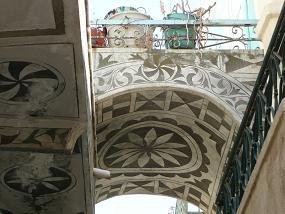
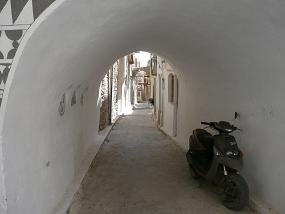
The mastic villages, or mastichochoria, are 20 fortified villages in the south of Chios that owe their name to the mastic resin grown here since the Middle Ages. The Genoese founded them inland in the 14th and 15th centuries for protection against pirates, and built them all in the same way: reinforced houses whose outer walls form a defensive ring, corner towers, flat roofs and narrow lanes laid out to confuse invaders. The low, evergreen mastic trees, one to three metres high, are notched each summer so their aromatic resin bleeds out and hardens in the air; about 300 tonnes are collected a year, and it goes into mastic gum, toothpaste and liquor. The villages were the only ones spared in the massacre of 1822 because their mastic was prized in the Ottoman court.
Pyrgi
Pyrgi is the mastic capital and the most famous of the villages, known for the brightly scored houses of its centre. Their facades are covered from top to bottom with black-and-white geometric patterns called xysta, a scratched plaster technique that is unique in Greece. The Byzantine church at the heart of the village and the main square framed by these patterned walls make Pyrgi the single most photographed place on the island.
Mesta & Olympi
Mesta is one of the best-preserved mastic villages, in the south-west of Chios, still ringed by its original defensive walls and threaded by narrow, partly covered lanes designed as a maze. Its 19th-century church of the Taxiarchis is the largest on the island. Nearby Olympi keeps a central square tower and the same fortified plan, and the three villages of Pyrgi, Mesta and Olympi are the ones most worth seeing. Mesta also offers restored village houses to stay in, listed in the Chios hotels guide.
Nea Moni monastery


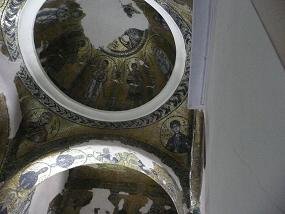
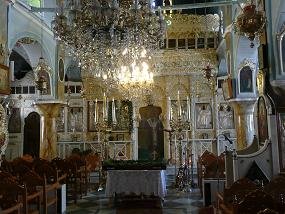
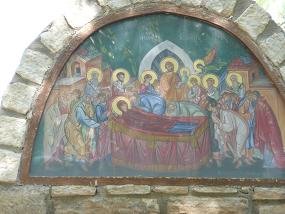
Nea Moni, the New Monastery, was founded in 1042 by the Byzantine emperor Constantine IX Monomachos, on the spot where three monks found an icon of the Virgin Mary. Its architecture and its mosaic and painting techniques are typical of the 11th-century imperial court art of the Macedonian dynasty, and the floor and wall mosaics that survive rank among the most important examples of Byzantine art of the 11th and 12th centuries. At the entrance stands the Chapel of the Holy Cross, holding the skulls and bones of monks, women and children massacred here in 1822, when the Turks nearly wiped out the population of Chios and burned the monastery. An earthquake in 1881 brought down the dome. Nea Moni lies 13 km west of Chios Town, reached by an impressive road through deserted mountain country, and it keeps a museum of monastery treasures.
Anavatos


Anavatos is a deserted medieval village in the north of the interior, built into the rocks so it could not be seen from a distance. It stands on top of a rock reached only from the south, and its name means inaccessible; the road up could be found only by islanders, which made it a refuge. In the massacre of 1822 the villagers were betrayed and many jumped into the surrounding ravine rather than surrender; the Turks killed the rest and burned the village. A few survivors rebuilt it, but the earthquake of 1881 destroyed the houses and the last inhabitants left. Today you park below and climb the stairs past the ruins, with olive and pine trees and deep ravines on every side.
Kambos




Kambos is a plain of walled citrus estates just south of Chios Town, laid out by the Genoese and later the Ottoman gentry. High stone walls line the lanes and hide mansions set among orange and lemon groves, many with old water wheels and stone-paved courtyards. It is one of the most beautiful areas of the island and holds the most exclusive place to stay on Chios, a converted 16th-century estate covered in the Chios hotels guide.
Daskalopetra
Daskalopetra, the Teacher's Rock, is a rock throne with a circle of stone seats at Vrondados, 4 km north of the centre of Chios Town. Tradition holds that the poet Homer taught here, though archaeologists prefer to read it as a cult place for the eastern goddess Cybele. The beach below is described in the Chios beaches guide.
Emporio acropolis
Above the village of Emporio in the south of Chios stands an ancient acropolis. A signed path climbs from the edge of the village to the Temple of Athena, with two altars and a megaron, the long hall used as a palace. Emporio itself sits by the black-pebble beach of Mavra Volia, covered in the Chios beaches guide.
Chios Town & the Kastro
Chios Town, the capital on the east coast, holds the sights of the modern island. The Kastro, a Byzantine fortress rebuilt by the Genoese, guards the harbour and contains the tomb of the Turkish admiral Kara Ali, who commanded the massacre of 1822. The Korais library, with more than 130,000 books, is one of the largest in the Aegean, grown around the legacy of the scholar Adamantios Korais. Near Vavili, 7 km south, the 13th-century Byzantine church of Panagia Krina is known for its frescoes and architecture. The town and its Kambos are set out on the Chios island guide.