Halkidiki (Chalkidiki): The Three-Fingered Peninsula Near Thessaloniki
Halkidiki, or Chalkidiki, is a peninsula region of northern Greece that extends south of Thessaloniki and sends three long “fingers” into the sea: Kassandra in the west, Sithonia in the middle and Athos in the east. The region is mountainous and green, its coast is lined with long sandy beaches, and its eastern finger, Athos, forms an autonomous monastic state of 20 monasteries beneath the sacred mountain. Fly into Thessaloniki and hire a car for the three peninsulas, covered in our Thessaloniki airport car rental guide.

- Region
- Northern Greece
- Peninsulas
- 3 fingers
- Near
- Thessaloniki
- Athos monasteries
- 20

Where Halkidiki is
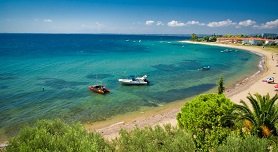
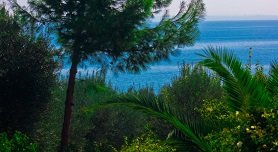
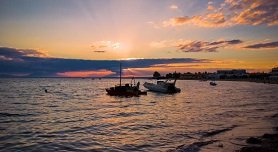
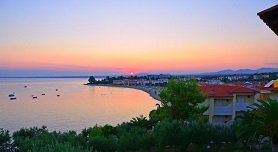
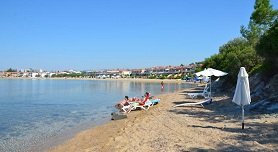
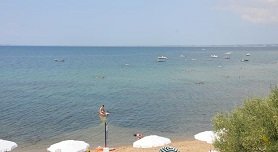
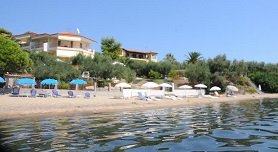
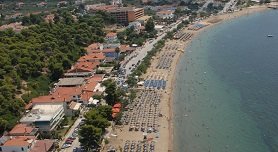
Halkidiki is a peninsula in northeastern Greece that joins the mainland at three points and extends south of the city of Thessaloniki. Three “fingers” reach further south into the sea — Kassandra in the west, Sithonia in the middle and Athos in the east. The land is mountainous and green, and the coast carries many long sandy beaches, which makes the region a summer destination for Greeks from Thessaloniki as well as foreign visitors. Above the three fingers, in the northwest of the area, several more coastal resorts line the shore between the peninsulas and the mainland.
The three peninsulas
| Peninsula | Position | Character | Best for |
|---|---|---|---|
| Kassandra | Western finger | Fishing villages and beaches, well equipped for tourists | Resorts and family beaches |
| Sithonia | Middle finger | Rugged and mountainous, small villages, many quiet sandy beaches | Nature and quieter coves |
| Athos | Eastern finger | Autonomous monastic state, 20 monasteries, restricted access | Pilgrimage and boat tours |
Each finger of Halkidiki has its own character. Kassandra, the westernmost, has been cut from the rest of Halkidiki by a canal at Nea Potidaia, now crossed by two bridges; it is well equipped for tourists, with many scenic fishing villages and beautiful beaches. Sithonia, the middle finger west of Athos, is very rugged and mountainous, with small fishing villages and many, sometimes deserted, sandy beaches; its capital is Nikiti, and it holds ancient sites such as Torone, a city that dates from the 8th century BC. Athos, the eastern finger, is the peninsula of the monks: it is only limited accessible and is forbidden to women. Off the Athos coast lies Ammouliani, the only inhabited island in Halkidiki.
Mount Athos and the monastic state
The Athos peninsula is named after the sacred mountain that stands at its southern end. The peninsula holds a special status, also in terms of tax, and is autonomous within Greece. Its capital, Karyes, was founded in the 9th century. On the peninsula stand 20 monasteries: the first was founded around a thousand years ago and the last in the sixteenth century, and in those days the monasteries could only be reached by boat or along narrow paths. Access remains restricted, and the peninsula is forbidden to women, so most visitors see Athos on organised boat trips along its coast.
Petralona cave and ancient sites
Halkidiki holds some of the oldest human traces in Greece. In a cave at Petralona a skeleton was unearthed that is among the oldest hominids, about a million years old, from one of the ice ages. Near Nea Potidaia archaeologists found the bones of a girl believed to be nearly 700,000 years old — the oldest skeletal remains ever found in Greece. The canal at Nea Potidaia itself was dug by order of Xerxes during the Persian invasion so his fleet could reach Athens more quickly, and the site had been settled since the 7th century BC by colonists from Corinth. In the northeast, near Olympiada, lie the remains of the ancient city of Stagira, the birthplace of Aristotle.
Mainland resorts and beaches

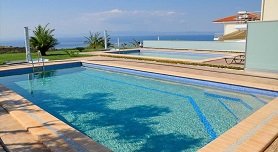
Between and above the three fingers, the mainland coast carries a string of resorts. Nea Moudania, a little over 50 kilometres from Thessaloniki, is the region's most important economic centre and one of the major fishing ports of Greece, with about 10,000 people. Paralia Dionysiou, three kilometres north of Nea Moudania, stretches along a three-kilometre beach of white sand where the shallow sea suits families with small children. Nea Kallikratia is a coastal town of about 5,500 people some 50 kilometres from Thessaloniki, while Gerakini and Psakoudia, on the strip between the Kassandra and Sithonia peninsulas, add long sandy beaches with tavernas, shops and campsites. Smaller places such as Flogita, Metamorfosi, Pyrgadikia and Olympiada round out the choice, most of them founded after 1922 by refugees from Anatolia.
Getting to Halkidiki
Halkidiki lies just south of Thessaloniki, so most visitors arrive through the city and its airport. Nea Moudania, the gateway to the peninsulas, sits a little over 50 kilometres from Thessaloniki and runs a regular bus service, roughly one bus an hour during the day. From the mainland coast, the three fingers spread out to the west and east, so it is worth choosing a base — Kassandra for resorts and family beaches, Sithonia for quieter coves, or the Athos side for boat trips past the monasteries.