Nisyros Sights: The Volcano, Mandraki Castles & Panagia Spiliani
The main sight of Nisyros is the volcano itself, a caldera 3 to 4 km wide that holds seven craters in the centre of the island. You can walk down into the main crater, Stefanos, across a floor of yellow earth and steaming vents. Around the capital Mandraki stand a Venetian castle, the older Kastro acropolis and the Panagia Spiliani monastery, while Nikia and Mandraki hold the island's museums and hot springs bubble up at Loutra and Avlaki. Hire a car to explore Nisyros at your own pace, covered in our Nisyros car hire guide.

- Marquee sight
- Volcano caldera
- Main crater
- Stefanos
- Oldest fort
- Kastro acropolis
- Largest monastery
- Panagia Spiliani





The volcano and caldera
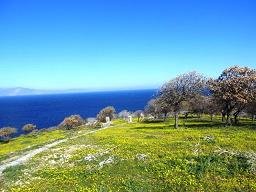
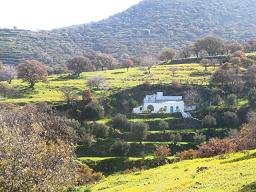
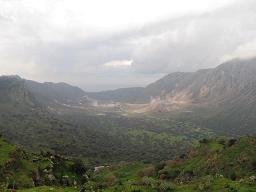


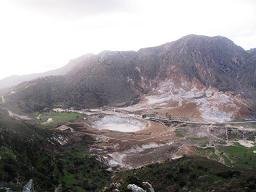
The volcano is the most important attraction of Nisyros, and the whole island is one large volcano. In the centre a caldera 3 to 4 km wide is ringed by hills and holds seven craters. The floor is a dry, yellow, lunar landscape where sulphur hangs in the air, in sharp contrast to the green outer slopes. You can walk down into the main crater, Stefanos, on foot. Travel agencies on the Mandraki waterfront sell trips to the crater, and buses run up from the town. The crater began forming about 150,000 years ago, and the last eruption, in 1888, threw out only steam. In myth the god Poseidon tore a piece off the island of Kos and threw it onto the giant Polyvotis, burying him alive, and every rumble of the volcano was read as the giant trying to break free.
The Venetian castle
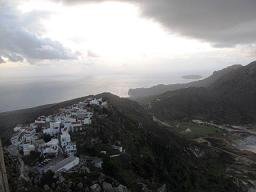
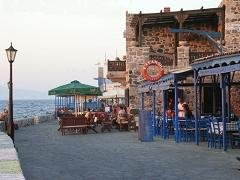
The Venetian castle of Nisyros stands on a hill on the west side of Mandraki. The Knights of St John built it after they conquered the island in 1315, and it looks out over the whitewashed town and the sea. It is one of two castles at Mandraki, the other being the older Kastro inland. Beside the castle sits the Panagia Spiliani monastery, so the hill above the town gathers the island's main historic sights in one place.
Kastro and the acropolis
Kastro is an older fort about 1 km inland from Mandraki, reached on the road that heads south from the town. Its walls are built of cyclopean stones, very large blocks, and its entrance is made of lava rock. The fort stands on the site of the ancient acropolis of Nisyros, the classical citadel of the island. Inside the walls there is little else to see, but the walls themselves are the finest ancient remains on Nisyros.
Panagia Spiliani monastery
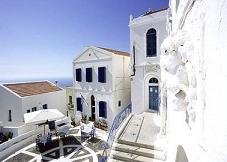
The Panagia Spiliani monastery is the largest monastery on Nisyros, on the hill west of Mandraki next to the Venetian castle. It was built in 1600 around a cave, which gives it its name, Spiliani meaning of the cave. The monastery also houses an Ecclesiastical Museum of religious objects. It shares the hilltop with the castle above the capital, an easy climb from the town.
The museums of Nisyros
Nisyros keeps several small museums. The Volcanological Museum sits in a former school at Nikia on the crater rim, with information and pictures of the volcano and a view of the caldera. The Archaeological Museum stands beside Heroes Square in Mandraki, with finds from prehistoric settlements, the ancient necropolis of the town and a cemetery on the nearby island of Gyali, alongside early Christian and Byzantine objects. The Folklore Museum, in the old town hall on the road to the Panagia Spiliani monastery, shows traditional costumes, farm tools, photographs and weapons, and the Ecclesiastical Museum in the monastery holds religious objects.
Hot springs and boat trips
The volcano feeds hot springs on Nisyros. At Loutra, in the north near Mandraki, the springs are said to help against arthritis and rheumatism and rise straight from the volcano, and more hot springs bubble up at Avlaki in the south. From Mandraki, boat trips run in season to the nearby island of Gyali, or Yali, a small island of two hills with a fine beach, and to the beach on the tiny islet of Agios Antonios. These trips pair the volcanic landscape with a swim off the coast.