Tinos Sights: The Church, the Poseidon Temple & the Dovecotes
The main sight of Tinos is the Panagia Evangelistria church in Tinos Town, which houses a miracle-working icon and draws pilgrims to the island year-round. Tinos adds the ancient sanctuary of Poseidon at Kionia and its 650 old dovecotes to the church, so the island rewards a few days of exploring by car. Every sight below is easy to reach from Tinos Town, the base for touring the island. Hire a car to explore Tinos at your own pace, covered in our Tinos car hire guide.

- Main sight
- Panagia Evangelistria
- Icon found
- 1822
- Ancient temple
- Poseidon at Kionia
- Dovecotes
- 650
The Panagia Evangelistria church

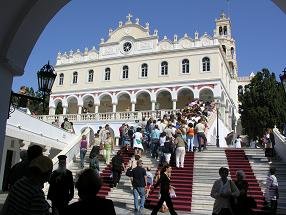
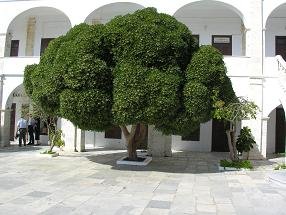
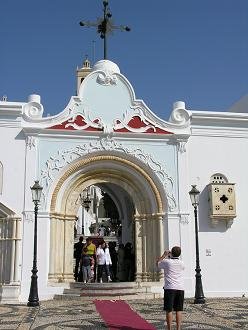
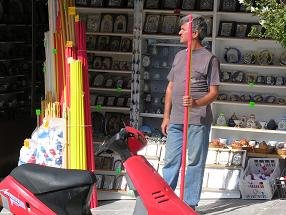
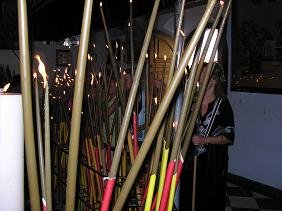
The Panagia Evangelistria is the great church of Tinos Town, and it houses the miracle-working icon that makes the island the pilgrimage centre of Greece. The icon is a piece of late-Byzantine art, said to come from a church destroyed by pirates in the 10th century, and it is believed to heal the sick. The icon came to light in 1822 after a nun had a vision, and it was dug up miraculously undamaged, so the church was built on the discovery site. Two roads climb to the church from the harbour: the wide procession road, where pilgrims sometimes crawl on their knees and metre-high candles are sold, and a narrow souvenir street. The church is beautiful inside, and its courtyard and the views over the town are worth the walk on their own.
The Poseidon temple at Kionia
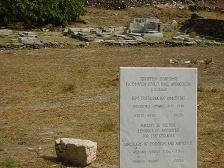
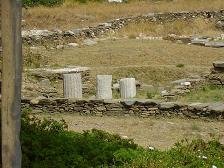


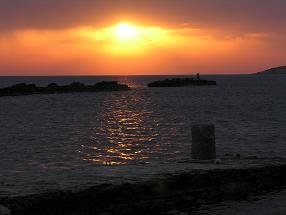
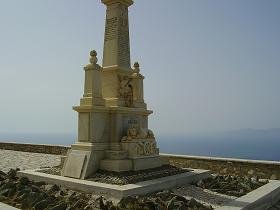
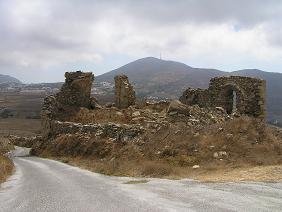
The sanctuary of Poseidon stands at Kionia, on the west side of Tinos Town near the beach. Mythology holds that Poseidon chased the snakes off Tinos, which was once called Ophioussa after them, so the islanders dedicated an important temple to him at Kionia. The ancient columns that give Kionia its name still mark the site by the sea. The sanctuary sits an easy 3 kilometres from Tinos Town, so it pairs well with a swim at Kionia beach.
The dovecotes of Tinos
The dovecotes of Tinos are the island's craft signature, and about 650 of them, mostly old, stand across the hills. Each dovecote is a small stone tower, and the islanders once kept pigeons in them as a specialty of Tinos. The dovecotes are scattered over the whole island rather than gathered in one place, so they turn up on almost every drive between the villages. They remain the detail that most sets the landscape of Tinos apart from the other Cyclades.
The history of Tinos
Tinos carries a long history, and its ancient names describe the island: Ophioussa for its snakes and Ydroussa for its water. The first settlers were probably the Phoenicians, the Ionians followed around 1000 BC, and two Mycenaean tombs were found at the village of Kyra Xeni. The island joined the league of Delos until 386 BC, then passed through Macedonian, Ptolemaic and Roman rule, and in the Byzantine period its people moved inland to escape pirate raids. The Venetians conquered Tinos in 1207 and held it in prosperity until 1715, and the Turks never managed to take it, so Tinos flourished as the economic capital of the Cyclades with a population between 24,000 and 28,000. Tinos was the most populous island of the Cyclades until 1821, and it became part of modern Greece in 1830.
Plan your visit
The sights of Tinos work best from a base in Tinos Town, with the church a short walk uphill and the temple, dovecotes and villages a short drive away. The Panagia Evangelistria draws the pilgrims, Kionia keeps the ancient temple, and the dovecotes fill the hills between the villages. See how the sights, beaches and villages fit together in the Tinos island guide.