Astypalaia Beaches
Livadi, over the hill from Pera Gialos, is the best and most popular beach on Astypalaia, a long organised strand of sand and small pebbles backed by citrus orchards. Because the island is so quiet, many of its beaches suit naturists, from the coves of Tzanaki and Agios Konstantinos south of Livadi to the remote sands of Vai in the north. Most visitors stay near Pera Gialos, the Chora, Livadi or Maltezana, but a moped, a good car or a walk opens up the rest, since many roads are dirt tracks.
- Best beach
- Livadi
- Naturist
- Tzanaki · Agios Konstantinos
- Quiet east
- Maltezana
- Remote
- Vatses · Vathi
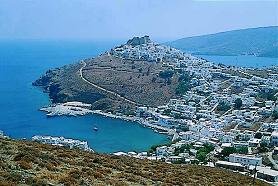
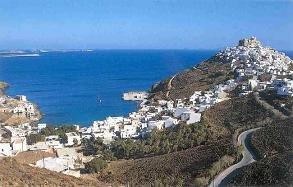
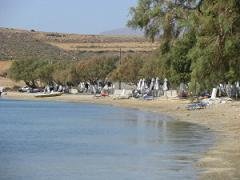
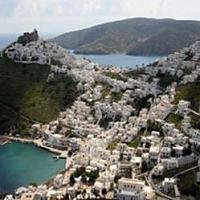
Livadi Beach
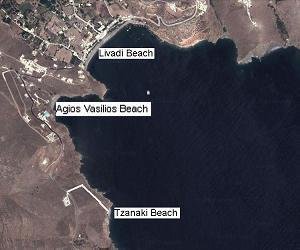
The best and most popular beach on Astypalaia is Livadi, close to the harbour of Pera Gialos and just over the hill, 3 kilometres from the Chora. It is a long beach of sand and small pebbles, backed by a fertile plain of citrus orchards, vines, orange and mandarin trees and flowers. Livadi is an organised beach with parasols and sunbeds for rent, and, as the main tourist centre of the island, it has shops, a mini-market, restaurants and a range of accommodation. Several quieter beaches and coves lie along the coast to the south and can be reached on foot.
Pera Gialos and the naturist coves
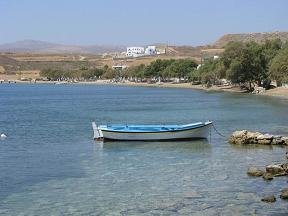
At the port of Pera Gialos itself there is a small sandy beach without sunbeds or umbrellas, shaded by a few trees and looking out over the harbour and its boats, with an ATM, shops, restaurants and an Archaeological Museum close by. Just south of Livadi, in the next cove of Pountari Bay, lies the small Agios Vasilios Beach, where naturism is not allowed. Walkers who continue south for about 600 metres past a house with a large pool reach the small pebble beach of Tzanaki, about 30 minutes on foot and one of the island's naturist beaches, with another small naturist cove in the bay beyond. More small beaches lie just north of Pera Gialos within walking distance.
Maltezana (Analipsi) Beach
Maltezana Beach, also called Analipsi Beach, lies 9 kilometres east of the Chora. It is a long, narrow beach of sand and a few pebbles, shaded by tamarisk trees and looking out over the small islets off the coast, with umbrellas and sunbeds available. It is said to be named after Maltese pirates who once sheltered in the bay, and it keeps a memorial to the French admiral Bigot, who blew up his ship's powder room in 1827 to avoid capture; ancient pillars stand around the memorial. Near the beach are the well-preserved Tallaras baths of the Hellenistic period, with blue and red-terracotta mosaics of the constellations and the seasons dating from the 5th century AD. The village behind is close to the island's small airport.
The islets and the hidden bays
In high season boats leave Maltezana beach for bays and islets around Astypalaia, among them Chondro, Ligno, Agia Kiriaki, Koutsomyti, Syrna and Kounoupi — the last meaning "mosquito island". Koutsomyti and Kounoupi each have a pretty beach; the one on Kounoupi is special, lying between the two parts of the islet and joining them, about an hour away by excursion boat. Within walking distance of Maltezana are more small spots: Plakes Beach, really just rocks to enter the water from, and Mple Limanaki, a tiny beach of grey pebbles hidden behind a rock wall with beautifully clear water. The larger beach of Vai, on the north side, is reached by path, car or moped and, like these coves, is secluded, quiet and suited to naturists, with no facilities, so bring your own water and food.
Agios Konstantinos and the south
South of Livadi, below Agios Vasilios and Tzanaki, lie Papou Beach and Moura Beach, hard to reach by land and probably best by boat. Further south, 7 kilometres from the Chora, is Agios Konstantinos Beach, named after a small church on the hill above it. It is a long sandy beach with a taverna, sunbeds and parasols in high season, popular with naturists and easy to reach by car or about an hour on foot from Livadi. The beach divides naturally into two, the taverna and beach beds on the southern part and the naturists on the north, with plenty of trees for shade and fine views to the Chora and its castle; it does not get too crowded.
Vatses, Kaminakia and Agios Ioannis
In the south-west, Vatses Beach is a long, wide pebble beach reached over an unpaved road or by excursion boat from Pera Gialos, with a small taverna and a few umbrellas in high season and trees for shade, though it can catch the wind. Near it is the Negro Cave, a pirate shelter of the Byzantine period reachable by boat, whose finds are shown in the Pera Gialos museum. Just north, Kaminakia Beach mixes sand and pebbles and has some facilities in high season, reached on foot, by good car or by boat. Agios Ioannis Beach is named after the beautiful cross-shaped, blue-domed church of Agios Ioannis Prodromou above it, with citrus fields in front and the remains of a castle on the mountain to its right; there are no facilities, and it is reached on foot or by boat.
The northern beaches and Vathi
On the north side, Psili Ammos ("fine sand") is reachable only by boat, as the way to it is dangerous, a beach of sand and pebbles ringed by rocky landscape. Panormos sits in an enclosed bay reached by a path, with no facilities and a few trees, and nearby Pachia Ammos ("thick sand") is now reached by asphalt road, a quiet beach with no facilities. Agios Andreas, the new ferry port, has a sandy beach just west of the village down a dirt track. Vathi, 21 kilometres from the Chora in the north-east, lies in an enclosed bay whose mouth is only about 50 metres wide, a shallow pebble beach that looks like a lagoon, with a few buildings, tavernas and rooms. Steno Beach, a few kilometres east of the Chora on the narrow waist of the island, is a fine sandy beach with shallow, easy water.