

<


THE TOWN OF CHANIA IN CRETE
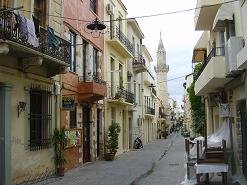
A lot of people claim that Chania is the most beautiful town on Crete, and this could be true, but it's a matter of taste. It's true that the centre of the town is attractive and has a lot of character and history, both Turkish and Venetian, but because Chania is such a popular destination it can also get quite busy. I've seen it a couple of times about 25 to 30 years ago and as I could have expected, nowadays Chania is much busier and trying to get into or out of the town can ask for some patience because of the heavy traffic on some places. There are many stop lights and not so many signs giving directions, so it can get confusing. The newly build concrete buildings on the outskirts heavily contrast with the historic and beautiful centre of the town. If you only would have a helicopter that can land you in the heart of the old village.... If you manage to get through all the busy traffic you will find a really nice and interesting town though.
Chania is one of the largest towns on the island of Crete and is packed with historical sights, a Turkish lighthouse and a Venetian fortress, and many buildings and houses dating from the Venetian and Turkish Ottoman times. It also has many shops, a large market and a charming harbour that houses many restaurants and caf�s. It is a really interesting town to spend some time in. Nowadays about 56.000 people live in Chania and it is the largest town in Crete after Heraklion.
The City of Chania already existed in the Minoan time and the was called Kydonia. In 828 AD, the city was conquered and destroyed by the Arabs and they gave the city a different name. In 961 BC the city fell into Byzantine hands. In the 14th century it was conquered by the Venetians that enlarged the fortress (Firkas from 1629) which can still be seen. Chania was faced with attacks by pirates (Barbarossa) and in the 17th century it was occupied by the Ottoman Turks. In the year 1913 Chania, just like the rest of Crete, became a part of Greece. Many of the old buildings that were erected in the course of time in Chania can still be admired. There is the Venetian port with the Venetian fortress and the lighthouse which dates from the Turkish times. If you walk through the old town you get to see a lot of Turkish and Venetian buildings.
Not far from Chania there are several beaches. To the west lie the vast sandy beaches of Daratso, Agia Marina and Platanias, northeast on the Akrotiri peninsula are some more intimate beaches such as the beach of Stavros, Kalathas or Tersanas, and on the east side the beaches Kalives, Almirida and Kalami are within easy reach of Chania town.
1 - remains of Minoan buildings indicate that there was a major settlement on the hill on the Kanevaro Odos. The excavations can only be seen from behind barbed wire and in other places scattered along the streets. For more information and pictures of these excavations (the old city of Kydonia) - click here.
2 - The port of Chania with its Venetian remains and the fishing boats. Of the 23 former big Venetian arsenals there are about 7 left.
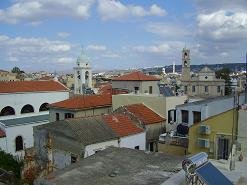
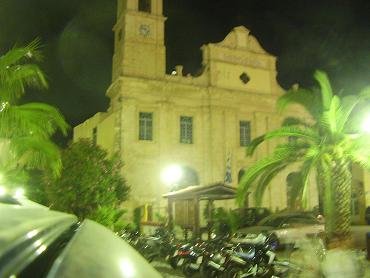
3 - The Agios Nikolaos church was originally a monastery-church and it was changed by the Turks into a mosque. They also built a minaret here. In 1912 a bell tower was added on the other side of the church. For information and pictures of this and other churches in Chania click here.
4 - The town-park of Chania. This park is located just outside the center and is a small place for a rest between the busy streets of Chania. It was made during the Turkish occupation and you can have a look at a few wild goats (krikri).
5 - The Turkish lighthouse at the end of the long pier in the port of Chania. The tower was restored and rebuilt in the 19th century.
6 - The arsenals in the port. Of the original 23 arsenals, there are about 7 left. They date from the 16th century and once the boats were repaired here.
7 - The market of Chania. This is a large covered market hall in the shape of a cross. Here many different things are sold from meat and fish to spices and sponges.
8 - The remains of the fortress of Firkas. Here are some remnants of the old fortress. Over the entire town of Chania many pieces of the old city wall are also preserved.
9 - The Janissaries Mosque near the port dates from 1654 and means something like "mosque on the banks".
10 - The Naval Museum has an excellent exhibition on the Battle of Crete and a collection of sea shells. In one of the streets behind it, behind the fortress there is the Byzantine Museum.
11 - The Archaeological Museum in Chania. For more info and pictures of this museum click here.
If you want to park your car in the town of Chania than do so in the free parking zone because if you don't you are likely to get a ticket very fast (65 euro - 2008). On Saturday mornings it can be quite busy in the town because it is market day. The Sundays are the most quiet for traffic, and most of the shops will still be open (in high season) but the covered market place is closed.
The port of Chania is picturesque with old Venetian buildings and houses that are painted in white, light blue and other pastel colours. In front of the Maritime Museum lie a large anchor and a large boat propeller. Most buildings in the port have a a kafenion, restaurant or souvenir shop in it, and in some of the houses you can rent a room. You can watch the fishing boats and sailing boats go past the lighthouse into the harbour. Everything in the port more or less lives from tourism and you can rent a horse-drawn carriage, take an excursion boat (there is also one with a glass bottom) or even have your portrait drawn. It's cosy and busy. In the harbour you will find the Janissar Mosque (also called the Mosque of Hassan Pasha), the lighthouse that dates from the Venetian period and the Venetian arsenals.
The lighthouse of Chania dates from the Venetian period (probably 1570). It is called the Pharos, and consists of large blocks of stone. In the middle of the 19th century it was restored by the Turkish Pasha Ali who built it up on the old Venetian foundations. The lighthouse is an Egyptian model and it has an Egyptian name, because the Egyptians also have restored the lighthouse during their occupation between 1821 and 1841 . After the last renovation the lighthouse was eventually entirely brought back to its former glory in 2006.
The Venetian arsenals or shipyards date from the late 15th century. The Venetian fleet dominated the Mediterranean at that time and here in the shipyards they built and repaired ships. The buildings are 50 meters long and 9 meters wide and they have 10 meters high vaulted ceilings. Previously they had large wooden doors and they were standing in the sea so the boats could easily enter. Now there is a quay in front of the arsenals and so this is no longer possible. I came across all kinds of different numbers on how many there once were and how many there were left. I personally counted 10 that are still in the harbour today: seven in a row and a little further at the end of another three.
The Chania market hall was built in 1913 and is considered one of the finest in Greece. It was built to celebrate the reunification with Greece (1912). The market hall was built in the shape of a cross and there are 76 shops in it. Here many different things are offered, both tourist items (handbags, shoes, sponges), as well as vegetables & fruits, herbs, olives, fish and meat. On Sunday the market is closed and on all other days it is open between 8.00 and 13.00 o'clock. On Wednesday, Thursday and Friday it is also open between 17.00 and 20.00.
In the east and west there are remains of the old Venetian walls. They covered a length of 5 km and were strengthened in the 16th century. The fortress Firkas stands at the entrance of the harbour and was intended to protect the entrance here. This fortress dates from the time of Turkish occupation and was rebuilt on the foundations of the old Venetian fortress that was built there in 1629. On this spot the Turks held the Greek rebels in prison. Today the Maritime Museum is located at Fort Firkas.
The Janissaries or Hassan Pasha Mosque, sometimes also simply called "Yiali Tzami mosque", meaning: the mosque along the shores of the sea. It stands in the port of Chania and dates from 1654. The Turkish invaders built it on the foundations of Venetian customs office (other sources say that it was on the foundations of a small church). It consists of one large dome and 6 small ones. The mosque used to have a minaret but it was destroyed in the early 20th century. The mosque has had many functions over the years. Nowadays it is used as a place to hold exhibitions.
Mamma Mia ... the ice that you can buy here is truly delicious. Taste a piece of heaven in the "Odos Karadi & Dimitri", a side street of the Halidon Street, not far from the church of Agios Nikolaos. It looks beautiful, tastes great and there's lots of choice. Back in the building you can see people making the ice. The ice cream shops in the Netherlands (where I live ;) can learn something from them.
Our verdict: a 9 out of 10